
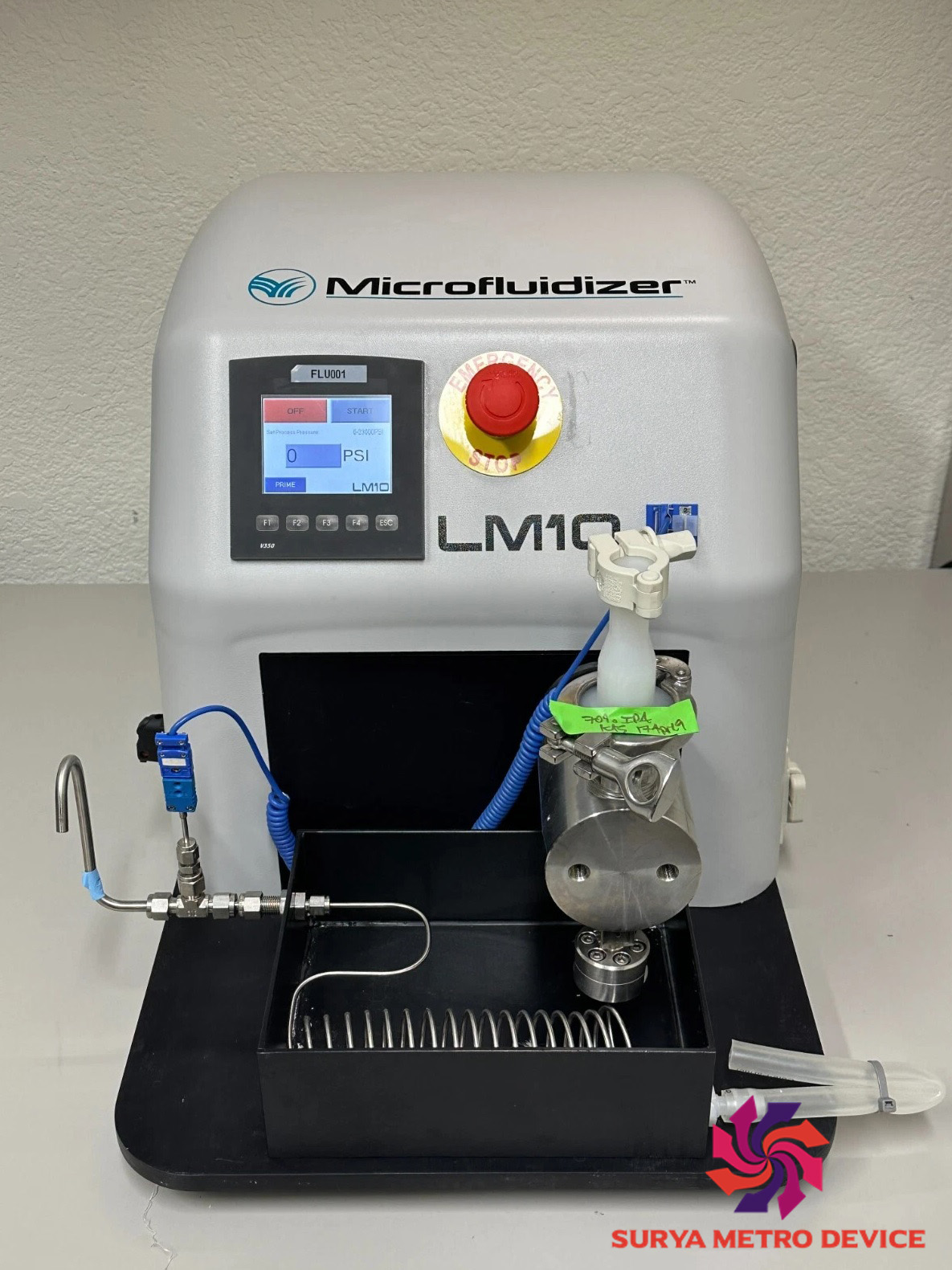

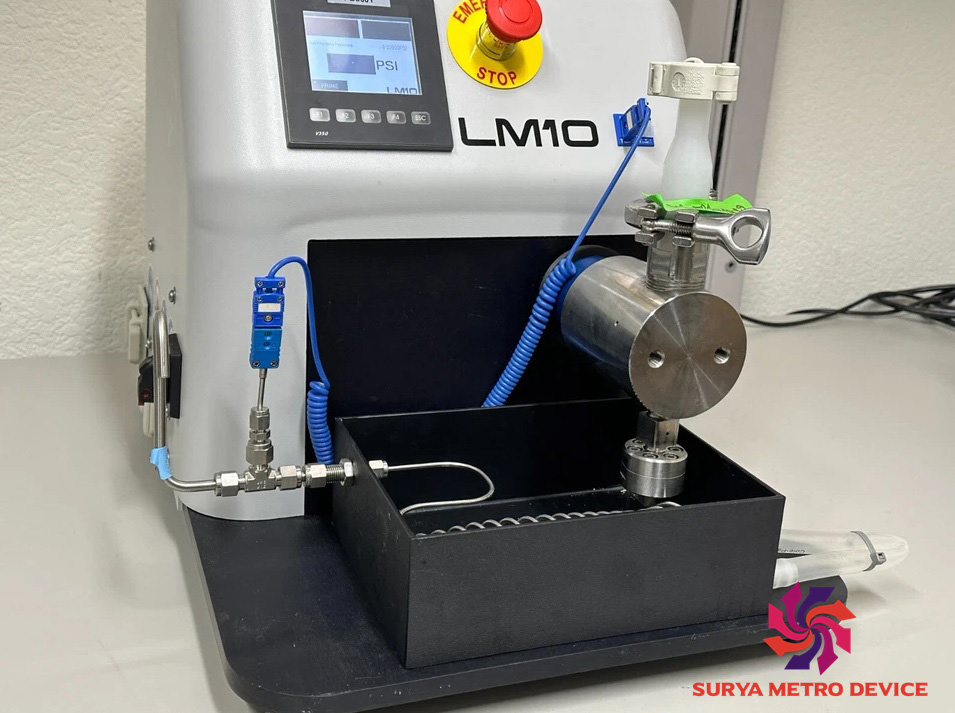

Microfluidics Microfluidizer LM10 Lab Homogenizer High Shear Fluid Processor
Manufactured by Microfluidics, the LM10 uses a controlled, high-pressure flow through a specialized microchannel chamber to deliver consistent processing conditions across a sample.
1. What is the LM10 used for?

Nanoemulsion and emulsion production
Produces fine oil-in-water or other emulsions with smaller, more uniform droplets for pharmaceutical, cosmetic, and food formulation research.

Liposomes and nanoparticle formulations
Helps reduce particle sizes and improve dispersion uniformity in lipid-based formulations and other suitable liquid suspensions.

Cell disruption and protein extraction
Applies intense shear and impact forces to break open cells, releasing intracellular proteins and other biological materials.

Particle-size reduction and deagglomeration
Breaks down particle clusters and improves the uniformity of dispersions, depending on the sample and processing conditions.
These are general application areas of Microfluidizer technology; actual results depend on the formulation, chamber configuration, pressure, and number of processing passes.
2. Key technical specifications
The following specifications are reported by the manufacturer and its technical distributors.
|
Specification |
LM10 details |
|---|---|
|
Equipment type |
High-pressure laboratory homogenizer |
|
Maximum operating pressure |
23,000 psi (approximately 1,586 bar) |
|
Minimum sample volume |
14 mL listed by some sources; manufacturer pages also state 30 mL |
|
Flow rate |
Approximately 250–600 mL/min |
|
Pump system |
Pneumatically driven intensifier pump |
|
Processing chamber |
Fixed-geometry ceramic Interaction Chamber™ |
|
Reservoir |
300 mL glass reservoir |
|
Temperature control |
Cooling coil and cooling bath |
|
User interface |
Digital touchscreen control |
|
Power requirement |
85–260 VAC, 50/60 Hz, 5 A |
|
Maximum feed temperature |
75°C, according to distributor specifications |
Important: The minimum sample volume varies between published specifications. Confirm the requirement for your exact LM10 configuration and processing setup before purchasing or preparing samples.
3. How does the LM10 work?
1. Sample loading
A liquid formulation or cell suspension is placed in the reservoir.
2. High-pressure pumping
The pneumatic intensifier pump drives the sample at controlled pressure.
3. Interaction chamber
The fluid passes through precisely defined microchannels, generating intense shear and impact forces.
4. Processed product
The treated material can have smaller particles or droplets, improved dispersion, or disrupted cells.
Operating principle based on the manufacturer’s technical description.
4. Advantages of the LM10
-
Consistent processing: Controlled pressure and fixed chamber geometry help achieve reproducible treatment.
-
Fine size reduction: Can produce submicron particles or droplets in suitable formulations.
-
Efficient cell disruption: Useful for laboratory biological sample preparation.
-
Temperature management: A cooling coil and bath help control heat generated during high-pressure processing.
-
Scale-up potential: Processing conditions can be transferred to compatible larger Microfluidizer systems to support product development.
Microfluidics+1
5. Who should use this instrument?
The LM10 is suitable for:
-
Biotechnology and molecular biology laboratories.
-
Pharmaceutical and drug-delivery formulation research.
-
Nanoparticle and liposome development laboratories.
-
Cosmetics and personal-care formulation research.
-
Food science and chemical formulation research.
-
University and industrial R&D facilities.
It is primarily a research and development instrument, rather than a general-purpose mixer or an instrument for measuring particle size. Particle size must be assessed using a suitable analytical instrument when quantitative measurements are required.
6. Maintenance and operating considerations
-
Inspect the interaction chamber, seals, and product-contact components regularly.
-
Use a suitable compressed-air supply and follow the manufacturer’s pressure and safety requirements.
-
Monitor product temperature during processing, especially for heat-sensitive proteins or biological samples.
-
Clean the fluid pathway thoroughly between samples to minimize cross-contamination.
-
Verify pressure control, temperature monitoring, and instrument performance according to the manufacturer’s maintenance procedures.
High-pressure operation requires appropriate training and adherence to the manufacturer’s safety instructions.
7. LM10 at a glance
Primary function
High-shear homogenization, particle-size reduction, and cell disruption.
Maximum pressure
23,000 psi
Typical applications
Nanoemulsions, liposomes, dispersions, and cell lysates.
Equipment category
Benchtop laboratory high-pressure fluid processor.




There are no reviews yet.