

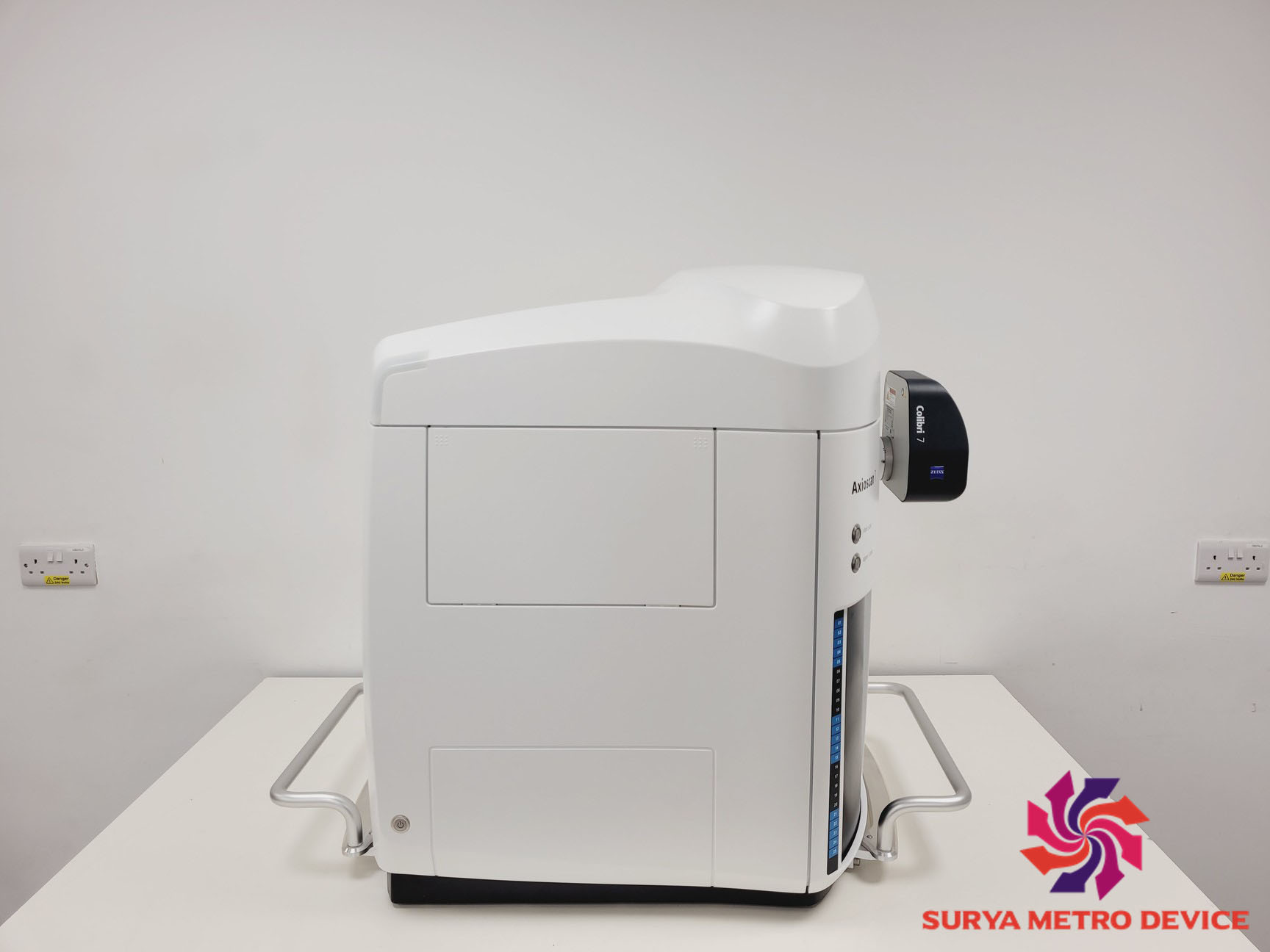




Zeiss Axioscan 7 Digital Slide Scanner
The model designation CYT5MF appears to be a specific configuration or ordering code. Exact included modules and capabilities should be confirmed from the instrument’s serial number, configuration label, or original quotation.
1. What does it do?

Absorbance
Measures how much light a sample absorbs. Common applications include ELISA, protein quantification, cell viability, and nucleic-acid assays.

Fluorescence
Detects fluorescent signals for applications such as fluorescent dyes, enzyme assays, reporter genes, and cell-based assays.

Luminescence
Measures light emitted by chemical or biological reactions, including luciferase reporter assays and ATP-based viability assays.

Cell imaging and microscopy
Captures images of cells in microplates for cell morphology, confluence, fluorescence localization, and other imaging-based measurements.
Not every measurement mode or imaging option is necessarily included in every Cytation 5 configuration.
2. Key technical specifications
The manufacturer’s technical datasheet and product listings describe the following capabilities for the Cytation 5 platform.
| Specification | Details |
|---|---|
| Detection modes | UV-Vis absorbance, fluorescence intensity, luminescence, fluorescence polarization, time-resolved fluorescence |
| Absorbance wavelength range | 230–999 nm |
| Microplate formats | 6–384 wells with monochromator reading; up to 1536 wells with filter-based reading, subject to configuration |
| Temperature control | Four-zone incubation up to 65°C |
| Temperature accuracy | ±0.2°C at 37°C, per technical specifications |
| Shaking | Linear, orbital, and double orbital |
| Light source | Xenon flash lamp; laser for Alpha detection where equipped |
| Software | Agilent BioTek Gen5 |
| Automation | Compatible with supported plate-handling systems |
| Imaging | Available on Cytation 5 imaging configurations; verify the specific model |
Important model distinction: The manufacturer’s datasheet identifies CYT5MF as a multimode-reader configuration. It lists filter- and monochromator-based detection modes, but optional Alpha detection and other accessories vary by ordering code. Confirm the exact installed features before purchasing or designing an assay.
3. Common research applications
-
Cell viability and cytotoxicity: resazurin, MTT-type assays, ATP luminescence.
-
ELISA and immunoassays: absorbance or fluorescence-based detection.
-
Protein and DNA/RNA quantification: suitable absorbance-based methods.
-
Reporter gene assays: luciferase and fluorescent reporters.
-
Live-cell studies: kinetic measurements with appropriate temperature and gas-control accessories.
-
Fluorescence polarization and TR-FRET: specialized binding and biochemical assays, when the required detection configuration is installed.
4. Software and documentation
The instrument is controlled using Agilent BioTek Gen5 software for measurement protocols, data acquisition, and analysis. Additional image-analysis features and regulatory-compliance software may require separate licenses.
Useful official resources:




There are no reviews yet.