
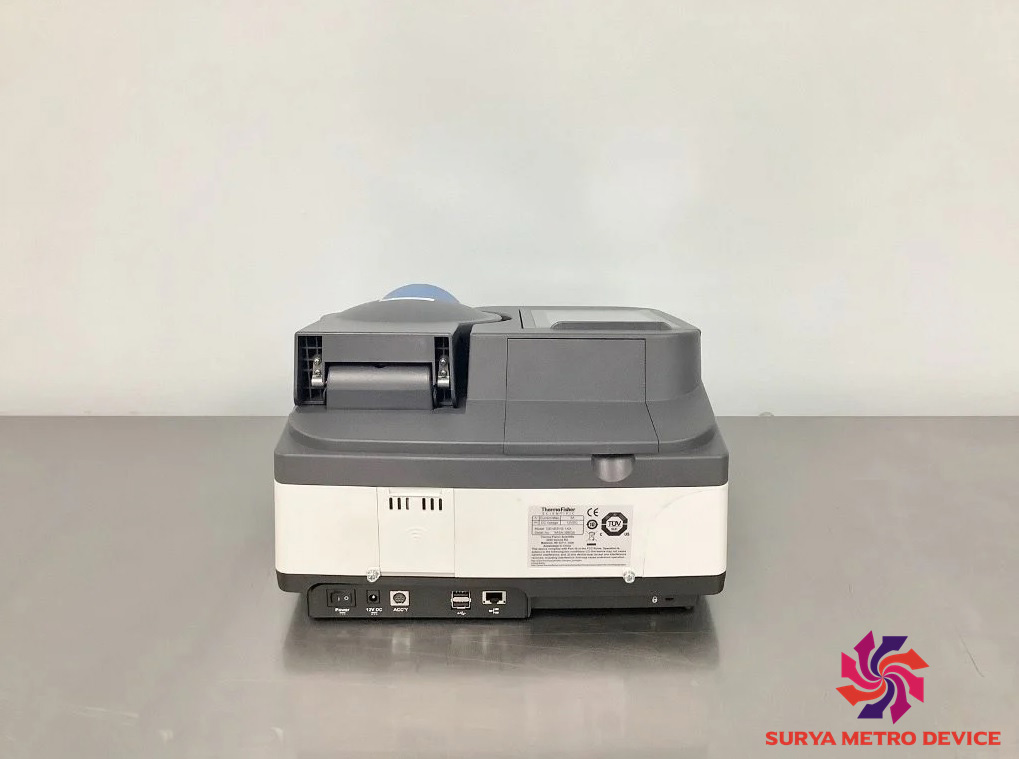


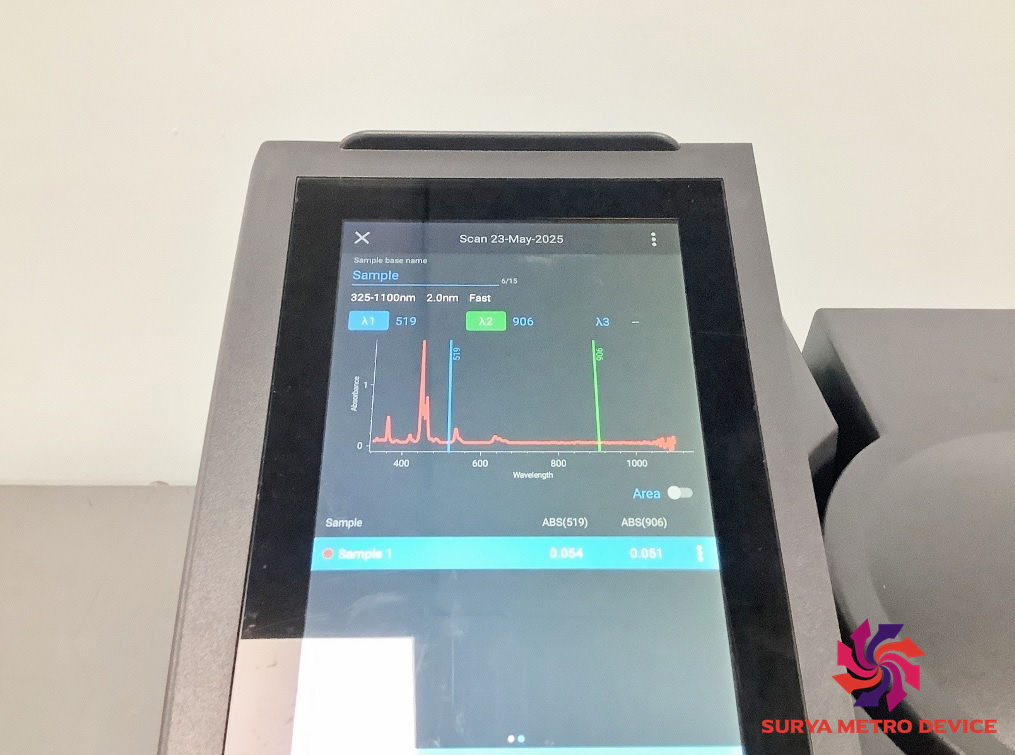
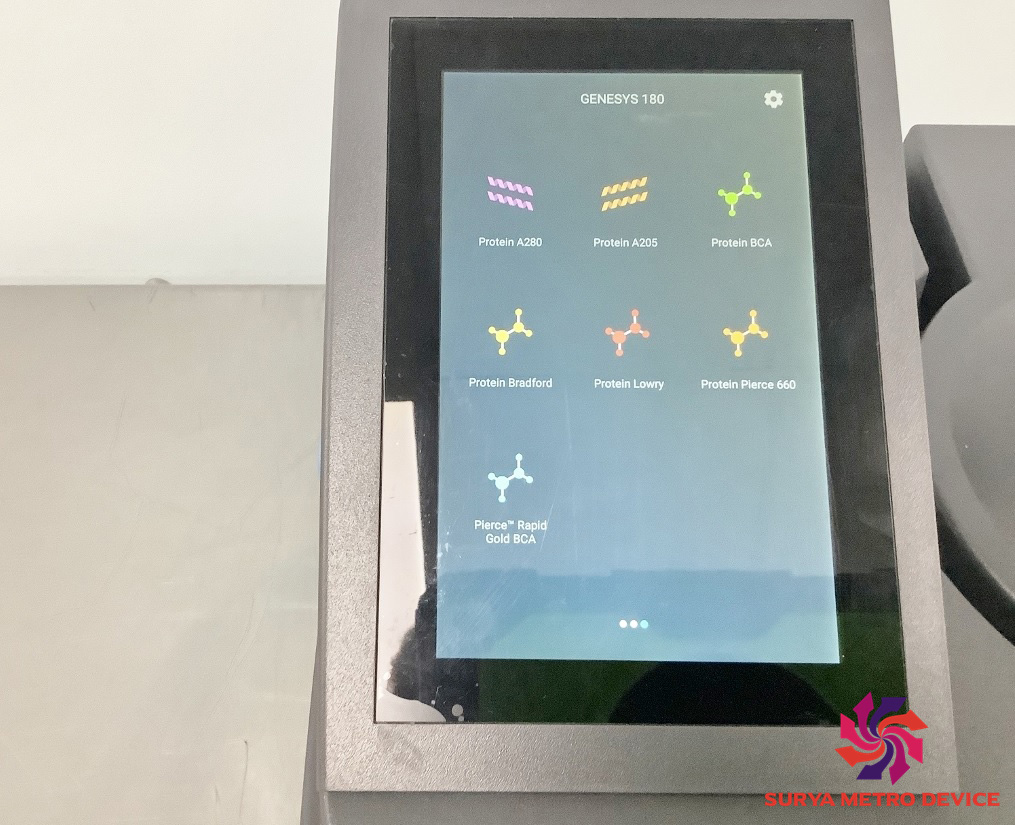

Thermo Genesys 180 Spectrophotometer
It is particularly useful in materials science, pharmaceutical research, polymers, forensic investigations, and industrial quality control.
1. Main functions

Microscopic chemical identification
Identifies materials by measuring infrared absorption patterns and comparing their molecular fingerprints with reference spectra.

Particle and contaminant analysis
Helps identify unknown particles, microplastics, fibers, foreign materials, and manufacturing contaminants.

Chemical mapping and material characterization
Examines chemical differences between small regions of a sample, supporting investigations of coatings, layered materials, and heterogeneous substances.

Pharmaceutical and product research
Can help characterize active ingredients, excipients, particles, and material distribution in pharmaceutical formulations.
2. Key technical specifications
The following specifications are for the RaptIR X platform; exact features depend on the selected configuration and accessories.
| Specification | Details |
|---|---|
| Manufacturer | Thermo Fisher Scientific |
| Instrument type | FTIR microscope |
| Infrared spatial resolution | 5 µm |
| Visible imaging resolution | 1 µm |
| Data acquisition speed | Up to 10 spectra per second |
| Measurement modes | Transmission, reflection, optional micro-ATR |
| Software | Thermo Scientific OMNIC Paradigm |
| Sample capacity | Up to 40 mm thick and 5 kg |
| Detector options | DLaTGS, MCT variants and optional InGaAs, depending on configuration |
| Typical configuration | Standalone microscope or integration with compatible FTIR spectrometer |
3. How does it work?
Step 1 — Locate the sample
The optical microscope helps the operator select a particle or microscopic region of interest.
Step 2 — Collect infrared spectra
Infrared light interacts with the sample, producing a spectrum characteristic of its molecular bonds.
Step 3 — Identify chemical composition
Software processes the spectrum and can compare it with reference libraries to help identify the material.
Step 4 — Generate chemical maps
When configured for mapping, the system shows how chemical components vary across the sample.
4. Industries and applications
-
Pharmaceuticals: ingredient distribution, excipient identification and formulation research.
-
Plastics and polymers: polymer identification, multilayer films and material defects.
-
Environmental science: microplastic and particulate identification.
-
Forensic science: trace fibers, paint fragments, inks and unknown materials.
-
Electronics and manufacturing: contamination investigations, coatings and product failure analysis.
-
Geology and heritage conservation: mineral identification, pigments and historical materials.
Thermo Fisher Scientific – ES+1
5. Advantages and limitations
Advantages
-
Provides chemical information from microscopic regions rather than only bulk samples.
-
Combines visual microscopy with infrared chemical analysis.
-
Supports rapid acquisition, automated particle workflows and chemical mapping.
-
Offers configurable detectors, sampling accessories and spectrometer integration.
Limitations
-
Infrared spatial resolution is approximately 5 µm, so smaller features may not be resolved independently.
-
Some samples require preparation or a suitable transmission, reflection or ATR method.
-
Advanced capabilities may require optional accessories, compatible spectrometers or an automated stage.
-
Reliable identification depends on sample quality, spectral quality and appropriate reference data.
6. Product information and official resources
For configuration details, manuals and quotations, consult the manufacturer:
In summary: The Nicolet RaptIR X is a research-grade FTIR microscope for identifying microscopic materials and mapping their chemical composition. It is particularly valuable when a laboratory needs to investigate small particles, contaminants, coatings or material defects that conventional bulk FTIR analysis may not characterize adequately.
There are no reviews yet.