
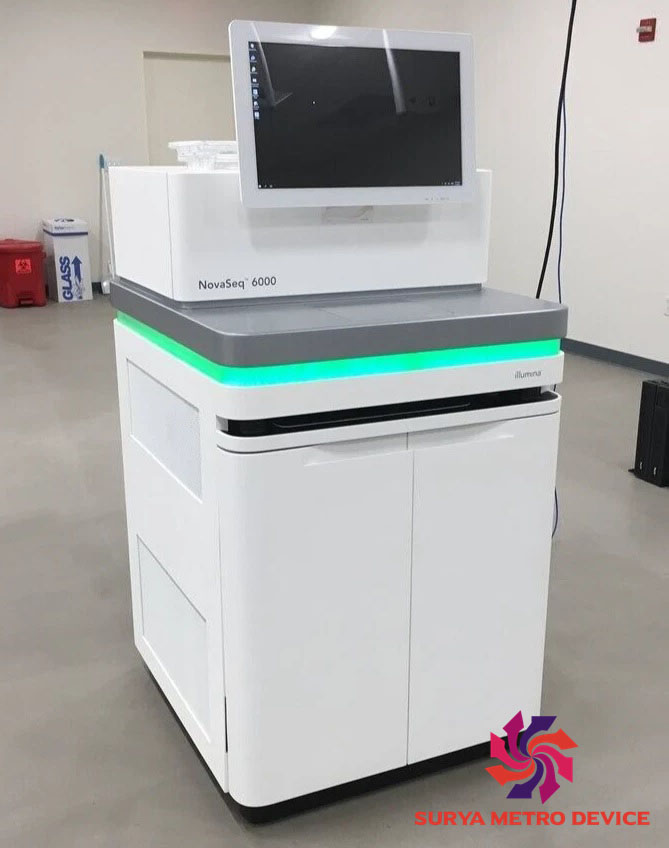

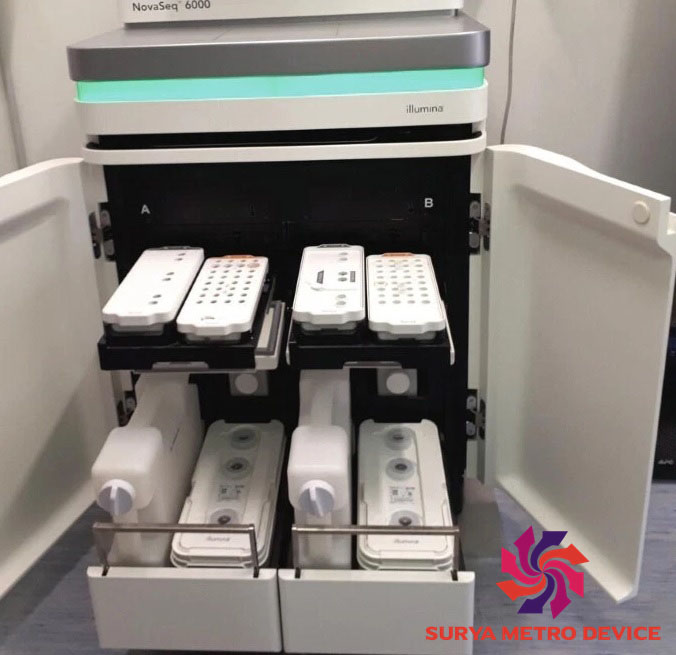

Illumina Novaseq 6000 nextgen sequencing system
Key features
| Feature | NovaSeq 6000 |
|---|---|
| Manufacturer | Illumina |
| Technology | Sequencing by synthesis (SBS) |
| Sequencing type | Short-read, paired-end or single-end |
| Maximum read length | Up to 2 × 250 bp, depending on kit |
| Flow cells | S1, S2, S3, S4 |
| Maximum output | Up to ~6 Tb per run with S4, depending on chemistry/read configuration |
| Applications | WGS, WES, RNA-seq, metagenomics, targeted sequencing, etc. |
| Detection | Fluorescent imaging of incorporated nucleotides |
How it works
- Library preparation – DNA/RNA is converted into sequencing libraries and adapters are added.
- Cluster generation – Libraries are loaded onto a flow cell, where individual molecules are amplified into clusters.
- Sequencing by synthesis – Fluorescently labeled nucleotides are incorporated one base at a time.
- Imaging – The instrument images each cycle to identify the incorporated base.
- Base calling – Raw images are converted into sequence data (BCL files).
- Data analysis – Reads are demultiplexed, quality-filtered and aligned or assembled for downstream analysis.
Typical applications
- Whole-genome sequencing (WGS)
- Whole-exome sequencing (WES)
- RNA sequencing / transcriptomics
- Cancer genomics
- Metagenomic sequencing
- Population genomics
- Targeted gene panels
- Small RNA sequencing
One important point: NovaSeq 6000 is a very high-throughput platform, so the appropriate flow cell and read configuration depend heavily on how many samples you have and the required sequencing depth.






There are no reviews yet.